
Date Addison Previous Residents
No source covers every era or proves both title and occupancy. Start with the row closest to the date being studied, then overlap it with a second source. The DuPage deed chain establishes recorded land interests. Address directories and census schedules offer household clues. Permits date work, while maps help match an old building footprint to a modern parcel.
| Source | Years it covers | Where held | What it shows |
|---|---|---|---|
| Recorder property records | 1839-present in office; online images from March 16, 1961 | DuPage Recorder, Wheaton | Recorded parties, land description, instrument, book/page |
| Online Recorder searches | Name 1961+; PIN 1985+; address 1995+ | Recorder documents portal | Different ways into the modern deed chain |
| DuPage County Directory | 1925-26 digitized; other cataloged local runs | IDA and library collections | Dated name, street, phone and local listing clues |
| Haines criss-cross volumes | 1988-2021; Near West Suburban 2004-2021 | Wheaton Public Library | Address-to-name snapshots |
| Telephone directories | Wheaton 1951-2016; suburban microfilm 1920-1971 | Wheaton Library and Addison Museum | Address, surname and phone continuity |
| Federal census | Public schedules through 1950 under the 72-year rule | Library databases and archival channels | Household members and relationships at a census date |
| Addison permits | Coverage not stated as one complete run | CityView and Village FOIA | Application, PIN, status, description and work dates |
A recent Addison address usually starts with the assessor and Recorder. A mid-century trail may begin with phone books and census schedules. For earlier land history, use the Recorder's public terminals, manual books, plats, and archival support rather than forcing an incomplete online result.
Fix Addison Past Residents to Land
Before collecting names, capture the current PIN and legal description from DuPage County Property Lookup. The card separates the situs address from the owner's mailing address and lists the subdivision or other legal land text. Those fields keep the research on the same parcel when street wording changes or the billing address points elsewhere.
Create four columns in the notes: situs address, mailing address, legal description or PIN, and USPS form. Record each exactly as its source shows it. A person named in the owner field may not have lived there. Likewise, a directory occupant may not have held title. The distinction is central to tracing previous residents.
- Grantor
- The party who conveys a recorded interest in land.
- Grantee
- The party who receives the interest and may become the seller in an earlier search.
- Chain of title
- The linked sequence of recorded transfers for the same land.
- Legal description
- The formal land identity, often based on subdivision, lot, block, or township and range.
Trace Addison Past Owners Backward
The current parcel card supplies the first named owner. Move from that record to the DuPage Recorder documents search. The portal accepts party names, subdivision or business name, address, PIN, document number, type, and dates. Its address cutoff is later than its name cutoff, so the search method must change as the trail goes back.
- Open the assessor card. Save the current owner, PIN, legal description, and any sales row linked to a Recorder document.
- Find the current purchase deed. Confirm the parcel through its legal description, not only the street wording.
- Read the seller as grantor. Search that seller as an earlier grantee to find when the seller acquired the land.
- Repeat the transfer sequence, logging recording date, document number, parties, and book/page when shown.
- When the online index ends, call Recorder Research at 630-407-5401 or use the public terminals and manual holdings in Wheaton.
This method establishes past owners, not automatically previous residents. A deed may name a trust, company, estate, or owner who received mail elsewhere. Add household evidence only after the land chain is secure.
Addison Past Resident Deed Cutoffs
The Recorder's cutoffs are uneven: online indexed images begin in 1961, PIN search begins in 1985, and address search begins in 1995. In-office property research reaches 1839, and plats reach into the 1800s. A blank address search before 1995 says little about whether the deed exists. Search names, legal descriptions, subdivisions, plats, and book/page references instead.
The historical inventory adds a harder gap. It describes missing volumes for 1860-1865 and 1874-1878, town-and-range arrangement for 1866-1873, and five books stolen during the 1871 courthouse fire. When a chain breaks in that period, ask staff about manual series and missing books. The gap may reflect the archive, not a missing transfer.
Counter tip. Bring a PIN, legal description, party variants, and date window to the Recorder instead of requesting every record for an address.
Bridge Old Labels for Addison Residents
No official Village-wide street-renumbering table was found. That makes plats and legal descriptions the safer bridge when an old address stops matching. Search subdivision, resubdivision, annexation, dedication, vacation, lot, block, or township and range in the Recorder's holdings. GIS can then place the legal parcel beside modern roads.
Lake Street offers a specific label problem. Addison history also identifies it as US Route 20, with earlier trail and stage-route context before paving in 1922 and entry into the federal highway system in 1926. Search both Lake Street and US 20. Rohlwing Road also marks a practical split between Addison and Bloomingdale township geography, so county and township labels may differ while the Village or postal city still says Addison.
Find Addison Past Residents by Address
Once a deed establishes the parcel and era, reverse sources can supply occupant clues. Wheaton Public Library holds Haines Criss-Cross volumes for 1988-2021 and Near West Suburban Haines volumes for 2004-2021. Its telephone resources include Wheaton books from 1951-2016 and Chicago suburban microfilm from 1920-1971. Addison Historical Museum also holds telephone directories, though its exact run is not published.
The Wheaton Public Library local-history collection shows the strongest documented address-oriented shelf for this work.
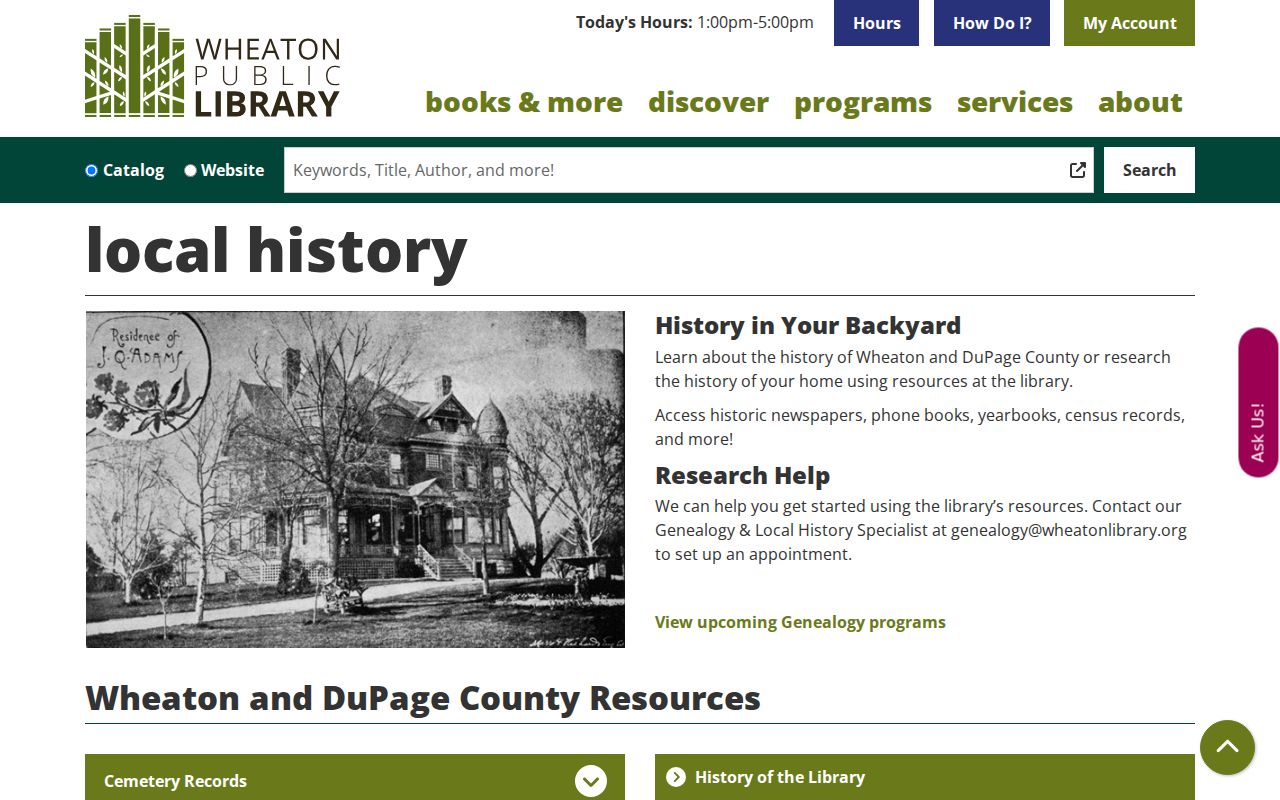
Its directory, census, cemetery, county-history, and genealogy resources allow one dated address clue to be tested against another.
Confirm the exact Addison volume before visiting. A criss-cross entry is a snapshot, not title proof, and an unlisted person may be absent. The collections and entry-reading methods are covered more fully on the Addison city directory page.
Pair Addison Past Residents and Census
The digitized 1925-26 DuPage County Directory supplies a dated Addison name-and-address layer. Its Addison section appears on printed pages 17-25, while the full object contains county, rural, and classified matter. OCR hits can land outside the local alphabetical section, so inspect the scanned page and printed-page context rather than trusting a text match alone.
- Choose a directory year close to the deed transfer and search the verified street form, surname, and spelling variants.
- Record the printed page, directory section, address, telephone, spouse or initial, and any residence mark exactly as printed.
- Open the nearest public federal census schedule. Use the 72-year release rule and compare the household, neighbors, occupation, and address context.
- Return to the next directory year. Mark who remained, arrived, or left without assuming the reason.
- Test the change against a deed, permit, newspaper notice, obituary, or probate file.
This overlap separates a one-year listing error from a durable household link. It also lets past residents appear in the story even when they never owned the Addison parcel.
Date Addison Past Resident Changes
Addison CityView Property Review can connect an address and PIN to linked permits. A permit may show an application number, status, description, issue, expiration, and final date. Treat it as a building timeline. It does not prove that the applicant or owner lived at the site.
Sanborn fire-insurance maps, county atlases, plat maps, and parcel geometry add a physical layer. The Illinois State Library map collections include Sanborn atlases and plat material, while the UIUC Sanborn collection advises checking address and cross-street coverage. Exact Addison sheets and dates should be confirmed before a visit.
When CityView omits an older public file, use Addison's JustFOIA request route. Ask for a precise address, record type, and date range. Inspection or electronic delivery may be more useful than broad paper copying.
Complete Addison Past Resident Trails
Newspapers and obituaries can explain a departure that deeds do not. Addison Public Library provides local-history and genealogy support, Addison Press material, yearbooks, and research databases. Addison Historical Museum adds family files, photographs, maps, blueprints, telephone directories, and clippings by appointment. Preserve the exact surname, street form, and date from the structured record before asking for help.
Probate files may name an estate, heirs, or property, but availability depends on the court file and any restriction. DuPage Circuit Clerk records are the official route for open case material and copies. Cemetery indexes, death records, and obituaries can then close a timeline, subject to their own access rules. A death record's genealogy threshold is not the same as eligibility for a certified copy.
Note: Pair one structured key, such as a PIN or deed number, with one context source, such as a newspaper or museum file.
Limits on Addison Previous Residents
An owner field, residential class, exemption, or tax mailing address does not prove who slept at a property. Directories may omit people, use abbreviations, lag a move, or reproduce an old label. Census schedules are snapshots. Permit applicants can be contractors or agents. Deeds can name trusts and estates. State confidentiality programs and legally protected records also limit what a search can show.
Write conclusions by date and source: “listed at the address,” “named as grantee,” or “shown as billing owner.” Do not turn those precise facts into a broad claim about every member of a household.
Lawful use. Research Addison previous residents for family history, house history, estates, or personal curiosity. Never track, threaten, harass, or harm a living person.